Skip to content

Map


Recent Articles

11
Jul

World Cup Final Photos

11
Jul

The Final

By Cynara Vetch

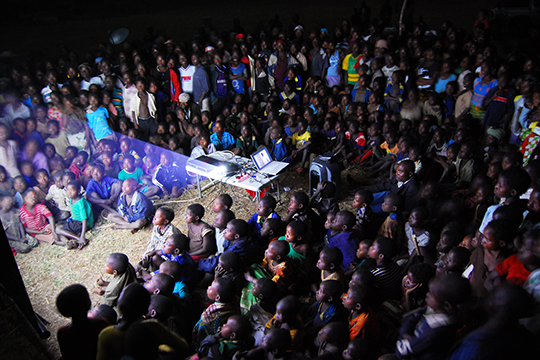
For the last game we projected the match wide and high across the wall of a town hall of Ward 13 in Jozini town, Kwa Zulu Natal.

Phineas Mpanza, the councillor of Ward 13  spoke to the crowd. “Feel it!” he cried, “It is here!” shouted back the crowd. Sthandwa Mnqayi, a Research Manger from AMREF who we were partnering with, explained “That ‘s one of the slogans for the World Cup and for the first time tonight it really is here for them.” 

Phineas was also in a celebratory mood “I feel good…that in my lifetime the World Cup is coming here. I was thinking can we do this? We are a small country  but as it continued and continued we saw that we are coming to a global world in South Africa and many people around here are very, very happy.”

We handed out HIV information packages in football bags and soon everyone was clutching one flicking through their booklets and examining their posters. Then we sat down for a One Love video about a couple who are both having extramarital affairs and how one HIV positive individual puts them all at risk.

As we projected the closing ceremony before the game, the crowd built up and filled the space. Shakira did her thing and the vuvuzelas blared out, the sound bouncing against the concrete walls and echoing around the room. Finally it was time for the match, the noise swelled and then died out as the players ran onto the pitch.

 Spain seemed in control for much of the game with the Dutch looking nervous at the opening of the match. The audience was evenly split between Dutch and Spanish supporters and both sides were frustrated about the lack of goals. After going into extra time it looked like we had to get ready for a penalty shoot out but after a tense 28th minute Spain managed to score a goal and we had a victor.

Now it’s all over and we’re driving to Johannesburg trying grasp the fact that the journey’s finished, mission accomplished. We’ve had the most incredible month. There has been malaria, countless car issues, some pretty sub standard food and sleep deprivation but there’s been so much more to outweigh that.

It has been 30 days of beautiful landscapes, unexpected moments and inspirational people. We’ve shared the love of football and pride in the African continent that won the right to host such a prestigious tournament. We’ve also worked with health workers and HIV activists in their drive to tackle the spread of the virus. So much work is being done, so much energy and inspiration is being directed towards this issue and we are proud to have supported some of the groups across Eastern and Southern Africa who hope to make Africa free from HIV.

10
Jul

Jozini Photos

10
Jul

Jozini

By Cynara Vetch

We drove out of Jozini town in Kwa Zulu Natal through a dusty, dusky pink sunset, our vuvuzelas blaring out the windows.  We were ready and excited for the penultimate game of the World Cup.

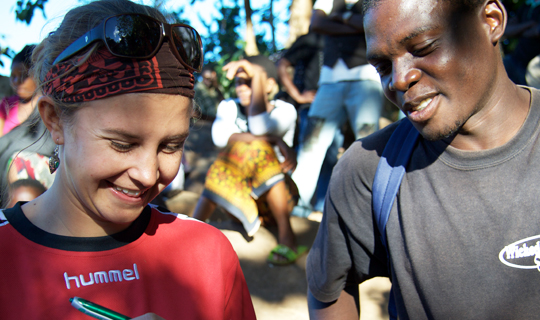
While we waited for a crowd to grow we put on some music videos and the place exploded. Every where we’ve gone any music has got people dancing and this was no exception, we had people shaking and swaying in the car spotlights round the screen and into the shadows at the back. It was turned into a bit of a competition and the slickest dance moves were rewarded with Africa Wins t-shirts and vuvuzelas.

It is great to be a part of the World Cup fever here in South Africa. Football is an important sport in the country and played a big role in South Africans day to day lives whilst they dealt with the brutality of apartheid. In his book ‘Africa United’ Steve Bloomfield interviewed John ‘Shoes’ Moshoeu, a former team member of Bafana Bafana, the national team.

Football during apartheid was a release, Shoes explained. Born and raised in Soweto at the height of the battles against apartheid, Shoes has been playing football since he was a small boy. ‘We could forget about everything else and just play,’ he said, whether they were kicking a plastic ball around the township’s dusty streets or watching the two giants of South African football, Orlando Pirates and Kaizer Chiefs, play at Soccer City.

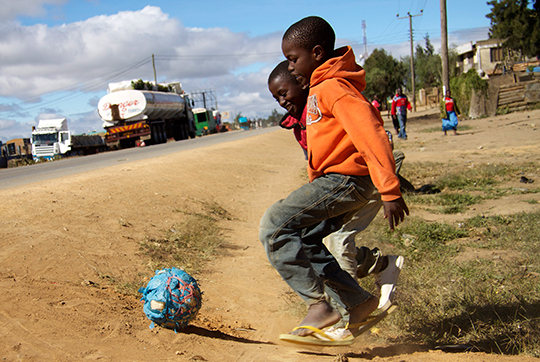
‘You can play anywhere, anytime. You don’t need specific equipment. You can get something round to kick about. For me, football is a poor man’s sport. It has given a lot of people from underprivileged societies a lease of life. It was something that would make us happy. Something where black people would be in a position to win, to conquer. Unlike other things.’ He’s old enough to remember ‘the fumes of the tear gas’ during the Soweto uprising in 1976, and was playing professional football in the township for Kaizer Chiefs during the last violent days of apartheid.

Nelson Mandela became the first black president in 1994 and South Africa is now basking in the glow of a successful World Cup. However the legacy of the past still impacts people living in the country today. We partnered with AMREF who run a project tackling Gender Based Violence (GBV) in the province of Kwa Zulu Natal in the North East of the country. Sthandwa Mnqayi  coordinates the programme , she told me “We grew up with a lot of violence within society and within the family. This has led to violence within relationships and we have a big problem with rape.”

For Sthandwa this aggression and violence against women is closely interlinked with the spread of HIV and AIDS “It is still a man’s world here” she noted “men have all the power in relationships they do what they want to do, women aren’t able to negotiate to use condoms.” All this means that the province of Kwa Zulu Natal has one of the highest HIV rates in the country, in the last census 39.9% of women who had been to an antenatal clinic were HIV positive.

For tonight at least the women seemed to be firmly in control, they definitely dominated the dancing,  one large lady in particular. She had a booming laugh and firm ideas on how to use the dance floor, “dance like a snake, move like a snake” she advised us and won a t-shirt effortlessly.

With no satellite hitches and a fun animated crowd it felt like a very special screening, particularly when Germany won. The match satisfied our German  supporters and we got our revenge on the Uruguians who had robbed Ghana of victory.

Only the final to go now and our Africa Goal journey is complete.

7
Jul

Swaziland Photos

7
Jul

Swaziland

By Cynara Vetch

We held our Swaziland screening below the Royal Palace of  King Mswati III, the small country’s polygamous king . We arrived to a football tournament wih a 4000 strong crowd and elaborate tents were up set up to host the Minister of Health and the Minister of Tourism. VCT testing was provided by PSI and NATTICC, a Swazi based HIV organisation .

Hon Benedict Xapa, the Minister of Health had taken up the Africa Goal project as an opportunity to tackle HIV prevalence in his country. Swaziland has the highest rate of HIV in the world. The day had been featured heavily on the country’s television and radio stations and we were excited to see a big spread on Africa Goal in the national broadsheet and a television feature the next day!

We were welcomed into the Kingdom by the Minister and were treated to a delicious banquet. The Ministry of Health and SAfAIDS had provided food for 800 people and volunteers had been cooking over fires in their traditional cast iron pots since 5:00 that morning.

A counsellor who didn’t want to be named explained why HIV has spread so far through the country “It is because of our traditional way of life” she noted “men often have many wives. We also have many traditions. which can put people at risk such as the practice of giving young girls from poor families to be junior wives to rich families.”

Currently the King has 13 wives, his father ended his reign with more than double this number and the custom is unlikely to change any time soon. Rather than criticise the practice HIV activists in Swaziland educate people on “the importance of protecting themselves with a condom every time they have sex and with every partner.”

There is also a big drive to encourage male circumcision, the government has pledged a 100% circumcision rate amongst young men. At the prize giving Mr Xapa spoke to the captains of the football teams and urged them to set up health clubs at their different schools, any groups that were established the minister to pledged to have funded, the idea is that these young men will be leaders for their generation and persuade their friends and class mates to stop the spread of HIV.

Having climbed the roof a building and hung the screen high so the crowd would be able to see the game, we spent a frantic four hours desperately trying to get our satellite reception. Sadly due to a cancellation of our subscription by DSTV and communication problems we weren’t able to get signal. We went the tried and tested route and streamed the match through a grainy television set.

The technical problems were frustrating but we all agreed that the warm welcome from the Swazi people was one of the highlights of our journey. A journey that is quickly coming to a close. Only two more matches to go and these will be held in South Africa, home of the 2010 World Cup.

6
Jul

Maputo Screening

The Waving Flag song, which has become synonymous with the Word Cup is blared out of speakers at the administration offices of the Zimpeto Barrio on the outskirts of Mozambique’s capital Maputo. A crowd of young students just returning from school quickly gathered and circled round a big screen, while we projected a video and later screened the Netherlands vs Uruguay Semi-final.

The HIV/AIDS community in Mozambique is working hard to educate people about the dangers of Multiple Concurrent Partners (MCPs) but there is need for a ‘mainstreaming’ of the issue. There is still a conservative attitude with regards to discussing subjects such as sexual behaviour and some HIV activists have been using the World Cup as a way to draw people to discuss the issue.

David Magaia is a Research Manager with Nweti Trust, Nweti is an organisation which focuses on health and development communication. He says that about 70% of people in Mozambique are involved in MCPs and that this a key driver for the 16.1% HIV prevalence in the country.

Working with the One Love Campaign Nweti Trust is trying to address this trend but it is not a simple task. David says “soccer is one of the events that brings people together different races, colours and creeds. Many people are so much involved in this that we can really spread the information about HIV. I think it is a wonderful thing and it works because we need to have a main streaming of HIV and AIDS in everything that we do.”

Football is avidly followed in Mozambique as it is in most of Southern Africa and the local administration in the Maputo District and Nweti Trust linked up to work with the Africa Goal project which has been screening the World Cup matches through East and Southern Africa and linking with local partners who are working in HIV/AIDS education and advocacy.

Fernando Chilwane the Secretario of the Zimpeto Barrio on the outskirts of Maputo where the screening was held. Fernando was a keen footballer in his youth but now has the physique of a successful politician and only plays for 10-15 minutes every now and then to remember the old buzz. He is concerned about HIV prevalence in the Maputo district, which has one of the highest rates in the country. He believes that events like this are key to support HIV activists because there is a lack of information amongst his constituents “Children don’t learn about health issues in schools and families never talk about it, people are embarrassed to talk about sex, we need more work on this and have more events such as these.”

Young Mozambiqans may be coy talking about sex with their parents but they are stylish and sassy and were more than happy to voice their opinions about MCPs at the screenings discussions.

One boy was inspired to recite some spoken word poetry, he strode out into the centre of the circle, his beanie pulled low and the microphone in his hand. David translated the Portugese “The poem was about the African cries, people crying because of what HIV is doing in Africa. He mentioned the behaviour of many young people he spoke about inter generational sex…. all these things bring about the spread of HIV which is killing so many people. Even though he ended up by bringing the aspect of hope we hold our hands together still we can have a better future.”

The Africa Goal project continues onto Swaziland now but the local government and CBOs in the area will now be looking for similar initiatives which David belives will “boost the efforts that are being done to reduce the spread of HIV and…motivate us further.”

6
Jul

Maputo

By Cynara Vetch

Today’s  screening was in the capital Maputo and after making up 900 HIV information football bags till 1:00 in the morning, we set off early for a 12 hour drive. We arrived at the administration headquarters of Zimpeto,on the outskirts of the city and then for the first time in 27 days we had satellite problems. As the minutes sped by kick off time grew nearer and the team got more and more tense.

Luckily we were working with David Magaia from Nweti Trust who was calm, professional and unwaveringly optimistic. Whilst we had technical difficulties David ran a One Love video about Multiple Concurrent Partnerships (MCPs) and then led a discussion.  David believes that about 70% of people are in MCPs and  HIV prevalence in Maputo district is one of the highest in the country.

David told me “It’s about passion, I feel I have responsibility because when one has knowledge, he has to pass that knowledge to other people. I’m a reverend and I talk to my church a lot about HIV, I feel I have responsibility to my community to tell people, tell my friends that there is chance of having our community free of HIV”

David is very enthusisatic about the project, he told the camera crew “We can be doing our work but there a new things that come that motivate us more and I think that Africa Goal initiative is in 2010 is one of the best initiatives which is motivating people to understand that the effort to fight HIV is not just for one person but is for all of us.”

The young men and women were confident and enthusiastic about the discussions and keen to explain what their experiences. It was great to see sophisticated, confident young women talking about their lives and relationships. Too often at our screenings the women have been reticent and shy while their male counterparts have dominated the events. David drew them out getting them talk about what they looked for in partner and how they could protect themselves from HIV.

Finally the technical difficulties were sorted and we caught the last 15 minutes of the Netherlands/Uruguay game, which turned out to be to be pretty exciting with Uruguay scoring a second goal in the 89th minute of the game. They didn’t equalise though and the team packed down with a sigh of relief, the Ghana defeat at the hands of the Uruguayians was still branded into us and we weren’t interested in seeing them go any further.

6
Jul

Paul’s story

By Cynara Vetch

Paul Kasououona is an HIV activist working in Zambia, the only straight man in the country who speaks out on gay and lesbian issues.

“I will never forget the day I discovered I was HIV positive. It was in 2000 and back then Zambia didn’t have any ARVs, The woman who tested me said that I was sick and that I could never recover, she told me to go home and prepare myself for death.”

“When I went back to my community everyone judged me. They said that I had been promiscuous, that I brought this illness on myself and that I should not accept sympathy. That was when I decided to leave Zambia.”

Paul had a plan “There was a civil war going on in Angola at the time, anyone who could do business there earnt much more money because it was so dangerous. I decided to go there to trade Zambian goods. My plan was simple, I was going to earn enough money to pay for my funeral, I wasn’t going to have any of my family spending their money and begrudging it because I was HIV positive.”

“When I reached Angola I set up my stall in the area allocated for foreigners but I wasn’t there long. One night at a bar a white man heard me speaking English on the phone, this was unusual in Angola and he wanted to hire me straight away.  This turned out to be very lucky, one day he came to me because he had heard that they were now giving out ARVs in Zambia.”

Paul planned to return to Angola once he had his medication but it did not work out that way “When I reached Lusaka I began to see what was happening in my country. There were ARVs in Lusaka but they didn’t reach any further, many people were dying in the countryside. I couldn’t return until everyone had access to the drug.”

Paul has been working as an HIV activist for over 10 years now. He’s an outspoken critic of the government and controversially he works amongst Zambia’s underground homosexual and lesbian community. Homosexuality is illegal in the country and he has faced discrimination and shrinking job opportunities because of his advocacy for gay rights. He remains however undeterred

“If AIDS didn’t kill me, what can anyone else do” he asks “nothing scares me now.”

5
Jul

Vilanculos Photos